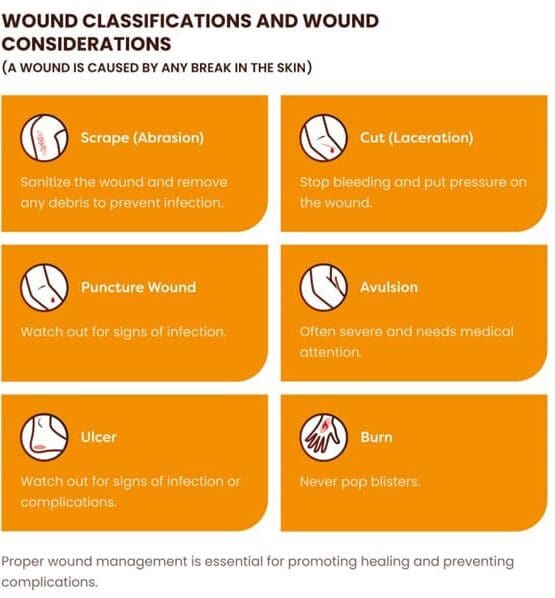
Injuries are an unfortunate but inevitable part of life, ranging from minor scrapes to more serious lacerations. Knowing how to accurately classify a wound and administer appropriate first aid can significantly impact healing time, reduce the risk of infection, and prevent further complications.
This article will guide you through the common types of wounds, helping you to identify them correctly, and provide simple, actionable steps on how to treat each effectively, empowering you to care for yourself and others when accidents occur.
TREATMENT OF MINOR ACUTE WOUNDS AT HOME:
Step 1
Assess wound
Step 2
Clean hands thoroughly with water and soap or cleanser with disinfectant properties (such as products containing Povidone-iodine)
Step 3
Stop the bleeding
Step 4
Clean the wound thoroughly and apply an antiseptic (such as Povidone-Iodine)
Step 5
Use an antiseptic ointment (such as Povidone iodine) on the wound to keep it moist
Step 6
Cover the wound
Step 7
Change the dressings daily or when they get dirty or wet. Avoid tearing delicate skin
Step 8
Consult a healthcare professional if you notice signs of infection (e.g. redness, swelling or pus)
TREATMENT OF MINOR BURN WOUNDS AT HOME:
Step 1
Cool the burn under cold water for 10-20 minutes (don’t use ice)
Step 2
Remove any items that may constrict the burned area.
Step 3
Don’t break blisters.
Step 4
Clean the wound and apply an antiseptic (such as Povidone-Iodine)
Step 5
You can also apply an antiseptic ointment (such as Povidone-Iodine)
Step 6
Apply a clean bandage and cover
Step 7
Consult a healthcare professional if symptoms persist.
ALL-2026-01-0011